






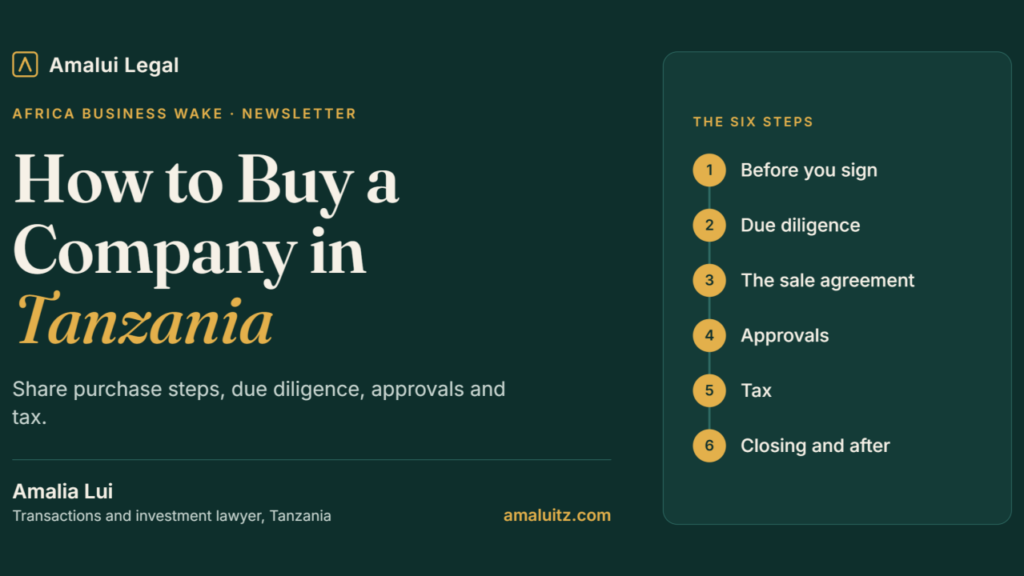
Buying a company in Tanzania is very doable. In most sectors a foreigner can own shares in a local entity, and deals of every size get done. The process does have its own rhythm, and buyers who treat it like a deal offshore without local law inputs are the ones who get caught out.
The usual surprises are an approval nobody planned for, a tax cost nobody priced in, or a licence that did not survive the change of owner. None of these is hard to handle if you see it coming. This guide walks through a purchase from the first conversation to the weeks after closing, in plain language, so you know what to ask and when.
The short version
- Decide early whether you are buying the company’s shares or its assets.
- Settle confidentiality, heads of terms and exclusivity before you spend money on advisers.
- Do proper due diligence, shaped by what you plan to do with the business.
- Find out which approvals the deal needs. Competition clearance usually sets the pace.
- Work out the tax before you sign, not after.
- Put the protection into the sale agreement, then close properly and finish the filings.
Share purchase or asset purchase?
The first big decision is what, exactly, you are buying, and it shapes almost everything that follows.
In a share purchase, you buy the shares from the current owners. The company carries on exactly as it is, with its contracts, licences, employees and bank accounts. But it also brings its past with it, including any tax problems, disputes or breaches nobody has told you about.
In an asset purchase, you choose the assets or the business you want and to some extent leave the rest behind. That can to a limited extent keep old liabilities out. The trade-off is more paperwork: contracts, permits and land rights usually have to be moved one at a time, and some licences cannot be transferred without the regulator’s pre-approval or prior notification. For some liabilities, especially tax, they can follow the asset(s) to the new owners, so tax due diligence is critical and do not rely solely on the annual tax clearance certificates, these do not under any circumstances imply that the target entity doesn’t have pre-existing tax liabilities.
Practice guides report that share purchases are the usual route for private companies in Tanzania, mainly because you take the whole business, with its contracts, staff and licences, in one step. Asset purchases tend to be chosen when the buyer wants only part of the business, or is nervous about undisclosed target’s history.
The two routes compare as follows.
- What you get. In a share purchase, the company itself, as it stands. In an asset purchase, only the assets and contracts you select.
- Old liabilities. In a share purchase, they come with the company. In an asset purchase, they mostly stay with the seller, though not always especially when it comes to historic tax liabilities.
- Licences and contracts. In a share purchase, they usually stay in place, but some need consent or notice when ownership changes. In an asset purchase, they must be transferred or re-issued one by one.
- Employees. In a share purchase, they stay with the company. In an asset purchase, they do not move automatically, and consultation rules can apply.
- Tax and formalities. A share purchase involves tax on the sale and updates at the companies registry, BRELA. An asset purchase involves tax and formalities on each asset moved, and creditor-protection rules can apply.
- Often chosen when. A share purchase suits a buyer who wants the whole business running from day one. An asset purchase suits a buyer who wants specific assets, or wants to leave the history behind.
There is no universally right answer. Tax, sector rules and risk all pull on the choice, so ask your advisers to model (especially from a tax perspective) both before you commit to one.
Step 1: Before you sign anything
The early stage looks informal, but the choices you make here shape the rest of the deal.
Confidentiality. Sign a confidentiality agreement before the seller opens the books. It should cover the information shared and the fact that talks are happening. If you will see personal data about staff or customers, handle it with care, because Tanzania’s data protection rules reach further than many buyers expect.
Heads of terms. This short document, often called a term sheet, records what is being bought, the price or how it will be set, the key conditions and the timetable. The commercial deal is normally non-binding at this stage, but a few parts should bind: confidentiality, exclusivity, who pays costs and which law applies. Say clearly which is which.
Exclusivity. Due diligence costs real money. Ask the seller to deal only with you for a fixed period, so your spend is not wasted if another buyer steps in.
Think about approvals now. Even at term-sheet stage, the shape of the deal can decide whether a merger filing is needed. A deal can count as a merger when the shares being sold sit in an offshore holding company, or when control changes because debt is converted into equity. We wrote about this in Beyond the Term Sheet.
Do not act like the owner yet. Until the required approvals are in, the seller has to keep running the business. Competition rules can treat early integration, or a say over day-to-day decisions, as taking control before clearance, which attract penalties and risk refusal when application for approvals are eventually filed.
Step 2: Due diligence
Due diligence is how you find out what you are really buying. It works best when it is built around your plans for the business, not run as a generic checklist. A buyer who wants to expand needs different answers from one who wants to consolidate.
These are the areas that matter most.
- Company and ownership. Who really owns the shares, and do the company’s records match the registry? Shares in a private company are not freely transferable, so read the articles of association for consent or pre-emption rights that could block or delay the sale. Our note on pitfalls in articles of association explains why these clauses matter.
- Licences and permits. List what the business needs in order to operate. Check that each licence is valid, held by the right entity, and still works after a change of owner or needs the regulator’s approval. Those which are about to expire, it should be a CP in the transacting documents that they must be renewed successfully.
- Land and property. Check the type of title, who holds it, any disputes or boundary problems, and whether the land is being used for its permitted purpose. See our guide to land risks for foreign investors.
- Contracts. Look at the key customer, supplier, lease and loan agreements. Many contain change of control clauses that let the other side terminate or demand consent when ownership changes.
- Finances and tax. Review accounts, tax filings, assessments and disputes, and any dealings between the company and its owners. In a share purchase, the company’s tax history becomes yours. It is worth making official inquiries at the tax authority to obtain an updated statement of account of the target entity for certainty of existence or non-existence of tax liabilities.
- Employees. Check contracts, benefits, statutory contributions, pending claims and the key people you cannot afford to lose. Our note on unfair labour practices shows where employers get caught.
- Disputes and compliance. Ask about court cases, regulatory notices, investigations and the company’s own compliance policies.
- Intellectual property and data. Confirm who owns the trademarks, software and other rights the business relies on, including work created by staff and contractors, and check the relevant registries. Review data protection compliance too.
- Environment, community and ESG. This is critical in mining, energy and land-heavy deals. Look at environmental approvals, community commitments and ESG obligations.
- Investment incentives. If the company holds incentives or an investment registration, find out whether they stay in place after the sale and whether the authority must be told.
If the target is in mining, the questions go deeper, and our list of 30 questions investors ask about Tanzanian mining deals is a good place to start.
Read the findings for what they mean. A problem is not always a reason to walk away. It can become a price reduction, a condition that must be met before closing, a specific promise from the seller to cover the cost, or part of the price held back until the issue is resolved.
Expect patchy records. In many private companies, documents are incomplete or scattered. Missing paperwork is itself a finding, and it is better to learn that now than after you own the company.
Step 3: The sale agreement
The sale agreement is where what you learned in due diligence turns into protection. These are the parts that matter most.
- Price and payment. Is the price fixed, or adjusted at closing for things like debt and working capital? Is it paid in one go, in instalments, or partly held back? Think about currency too, which we come back to below.
- Conditions before closing. Write down everything that must happen before the deal can complete: competition and sector approvals, consents from lenders, landlords and key customers, and any clean-up the seller has promised. Add a long-stop date, the deadline after which either side can walk away, and make it realistic.
- Warranties. These are the seller’s statements about the business: the accounts, tax position, licences, litigation, employees and so on. Your due diligence shapes them, and the seller will try to qualify them with disclosures.
- Indemnities. For risks you already know about, such as a tax assessment or a land dispute, ask for a specific promise to cover the cost, rather than relying on a general warranty. The figure can be held off the purchase price until the expiry of the indemnity/warranty period.
- Protecting the money. A promise is only worth what you can collect. If the seller is offshore or a thinly capitalised holding company, consider holding part of the price back, using escrow, or asking for a guarantee from a stronger party.
- Conduct until closing. The seller should run the business normally and not take big decisions without telling you. Keep this balanced, because too much control before clearance can look like you already own the company.
- Seller restrictions. Non-compete and non-solicitation clauses are standard. Keep them tied to what you are actually buying and limited in time and place, because overly broad restrictions can be challenged.
- People. If particular managers are essential, deal with their contracts and retention before closing, not after.
- Costs and duties. Say who pays stamp duty, filing fees and other charges the deal triggers. Note that for capital gains, grossing up in practise may raise issues with the tax authority.
- Law and disputes. Choose the governing law and how disputes will be resolved. Many cross-border deals use arbitration, partly because an award can be easier to enforce abroad than a court judgment. If it is for controlled sectors like mining, it is worth checking the restrictions imposed on use of foreign arbitration forums and what exemptions are available.
- Localization. This is critical to consider depending on the sector within which the target company is operating under. Some sectors have mandatory local ownership requirements, including mandatory board seat to locals, and in some sectors, mandatory JV with the Government of Tanzania.
If you are not buying 100%, you will also need a shareholders’ agreement covering board seats, decisions that need your consent, how deadlock is resolved and how you can exit. That deserves its own article.
Step 4: Approvals
This is the stage that most often sets the pace. Work out early which approvals you need, who gives them and in what order.
Competition clearance
In Mainland Tanzania, the Fair Competition Commission (FCC) reviews mergers. A filing is mandatory where a deal changes control of a business or assets in the country and the parties pass a size threshold. At this time the threshold is TZS 3.5 billion (approx. $1,324,582) in combined annual turnover or assets of the merging firms, but confirm the current figure before you rely on it.
A few points surprise buyers:
- Offshore deals can be caught. Buying a foreign parent company that owns a Tanzanian business can count, because control of the Tanzanian business changes.
- You do not need a majority. A smaller stake can count if it comes with control rights, such as vetoes over the budget or senior appointments.
- You cannot close first. The regime is suspensory, so the deal must not be implemented until the FCC has cleared it. Closing early exposes you to heavy fines linked to turnover, and the FCC can order a deal unwound. It has pursued deals that were completed without a filing.
- Filings become public. The FCC publishes a notice and can invite comments from competitors, customers and others. Competitors can file an objection to the merger application and it can a take considerable time to have them heard and resolved/decided.
- Public benefits count. Since the 2024 amendments, the FCC can weigh benefits such as jobs, exports and skills transfer against competition concerns, so be ready to explain what your investment brings.
On paper, the timetable looks like this: The FCC has five working days to confirm the filing is complete, then 14 days for an initial review. If it opens a full examination, it can take 90 days, extendable by 30. In practice, it depends a lot on how complete your filing is and how many questions the FCC raises.
Regional filings
Since 1 November 2025, deals with cross-border effects in at least two East African Community states can fall under the East African Community Competition Authority (EACCA). It is designed as a one-stop filing, with its own, higher thresholds. However, the FCC legislation in Tanzania has yet to allow exemptions from local filing if the merger qualifies for filing at the EACCA, this means that dual filings may become necessary.
Zanzibar
Zanzibar has its own competition regime and regulator, and its own investment promotion body. If the target has a Zanzibar business or assets, that side needs to be analysed separately.
Sector regulators
Many industries need approval when ownership changes. Banks need the Bank of Tanzania, insurers need the Tanzania Insurance Regulatory Authority, and telecoms and utilities may involve the Tanzania Communications Regulatory Authority and the Energy and Water Utilities Regulatory Authority. Mining, oil and gas deals also commonly require regulator consent for a change of control.
Two practical points help here. First, some regulators will not issue their approval until they have seen the competition clearance, so the competition filing usually goes first or in parallel. Second, regulators tend to hold back if the company has unresolved compliance issues with them, so clean those up before you file.
The investment authority
Foreign investors usually deal with Tanzania’s investment authority, now called TISEZA, which is bringing together the former Tanzania Investment Centre and the Export Processing Zones Authority. If the target holds investment incentives, check whether they stay in place after the sale and whether the authority has to be told.
Listed companies
If the target is listed on the Dar es Salaam Stock Exchange, takeover rules apply, including disclosure, pricing and mandatory-offer obligations once a buyer crosses a control threshold.
Other consents
Not every approval comes from the government. Lenders, landlords and major customers may have rights that are triggered by a change of owner. Due diligence should list these, and the sale agreement should make the important ones conditions of closing.
Step 5: Tax
Tax is where deals most often lose value quietly, which is why it deserves attention from the first week, not the last.
The seller’s gain is taxed. Tanzania taxes gains on the sale of shares and business assets, including gains made by non-resident sellers. The rate and the mechanics depend on who the seller is and what is being sold, and they have been adjusted in recent Finance Acts. Check what applies on the day you sign.
Offshore sales are not automatically out of reach. The tax rules have been widened to catch some sales of overseas holding companies when the real effect is a change in who owns the Tanzanian business. If the seller plans to sell you an offshore company, take advice on this early.
The buyer can still be exposed. The seller is usually the taxpayer on its gain, but depending on the facts, a buyer may be asked to withhold tax from the price, or may face questions from the tax authority if the tax on the sale has not been dealt with. In a share purchase, the target company’s own past tax liabilities also stay with the company, and so with you.
Practical protections include:
- agreeing in writing who bears which tax and who pays it;
- holding back part of the price, or using escrow, where the position is uncertain;
- a specific tax indemnity from the seller, backed by something you can actually collect against;
- asking for evidence that tax on the sale has been paid or provided for.
Other charges. Stamp duty and similar charges can arise on share transfers, and on land or other assets in an asset purchase. Build them into your cost model.
Choose the buying entity with tax in mind. Whether you buy directly, through a Tanzanian company or through a holding company elsewhere can change what you pay on future dividends and on an eventual exit, including how tax treaties apply. Get tax advice before you choose the buyer, not after.
Step 6: Closing and what comes after
Closing is the day the conditions are met, the money moves and ownership changes. It is not the end of the process, because a good part of the legal work comes after.
On closing day. Expect a set of signed documents and handovers: the share transfer forms and share certificates, board and shareholder resolutions, the appointment and resignation of directors, new bank mandates, the company’s records and seals, and evidence that every condition has been satisfied. Keep a complete closing file.
Moving the money. Bring the purchase price in through the banking system and keep proper records. You will want a clean paper trail later, when you need to take dividends or sale proceeds out of the country.
Filings after closing. The company’s records at the registry (BRELA) need updating for the change in shareholders and directors. Beneficial ownership information has to be updated within a short period set by the regulations. Depending on the business, you may also need to notify the tax authority, sector regulators, the investment authority, the company’s bank and insurers, and counterparties whose contracts require notice.
Compliance calendar. Companies must file annual returns, and licences and permits have renewal dates. Put them all in one calendar in the first week, so nothing lapses because the previous owner used to handle it.
People. Talk to employees and key customers early and clearly. If you plan to restructure or reduce roles, there are formal consultation requirements that must be followed, and moving too fast is a common source of claims.
Integration. Resist the urge to change everything at once. Stabilise the business first, then make changes in a planned order.
If you are a foreign buyer
Everything above applies to you, plus a few extra points.
- Sector limits. Foreign ownership is allowed in most sectors, but some limit it or require local participation. Telecommunications, broadcasting and mining are commonly cited examples, as are some tourism and transport related activities. Check the target’s sector against the current rules before you spend money on due diligence.
- Land. Foreign investors generally cannot hold the main form of land title directly and access land through specific investment routes. If the target owns land, check how it holds it and whether a foreign owner affects its right to keep it. Our guide to land risks for foreign investors covers the detail.
- Know-your-buyer checks. Expect to be asked where the money comes from and who ultimately owns the buyer. Foreign companies are also asked for accounts and lists of shareholders and directors from their home country, so it helps to have these ready.
- Currency. Since March 2025, domestic transactions are meant to be conducted in Tanzanian shillings. Contracts in dollars between local parties may need revisiting, and there are exceptions, such as for foreign loans. Work out early how the price, any shareholder loans and future dividends will flow.
- Your people. If you plan to send expatriate managers, they will need work and residence permits, and employers are expected to prioritise local hiring and plan for local succession.
- Local advisers. A Tanzanian lawyer and tax adviser should be in the room from the start. Filings, approvals and local practice are hard to manage from outside the country.
Seven mistakes buyers make
Most of these are avoidable with early planning.
- Treating the term sheet as harmless. Exclusivity, costs and even the structure can lock you in, and the structure can decide whether a merger filing is needed.
- Acting like the owner before clearance. Early integration or a say over daily decisions can breach the rule against implementing a deal before competition approval.
- Running diligence off a generic checklist. The questions that matter depend on what you plan to do with the business.
- Leaving tax until late. If nobody owns the tax question, it tends to surface at the worst time, usually after the price is agreed.
- Overlooking licences and key contracts. In many businesses, the licences and a handful of contracts are most of the value, so check what happens to them when ownership changes.
- Underestimating the timeline. Approvals can run longer than expected, and a long-stop date that is too tight can let the other side walk away.
- Weak protection for claims. A warranty against an offshore seller with no assets in Tanzania is hard to enforce, so use retention, escrow or guarantees.
How long does it take?
There is no standard timetable, and anyone who gives you a fixed number of weeks without knowing the target is guessing. Most deals take months rather than weeks, and the approvals stage is usually the longest and the least in your control.
The main stages look like this.
- Early talks and heads of terms. You agree price, structure and timetable in principle. The time depends on how quickly both sides align on the basics.
- Due diligence. Documents are reviewed, questions are raised and risks are reported. The time depends on how complete and organised the seller’s records are.
- Negotiation and signing. The sale agreement and related documents are agreed. The time depends on how far apart the parties are on who carries which risk.
- Approvals. Competition, sector regulator and other consents are obtained. The time depends on regulator timetables and how complete your filings are.
- Closing. Conditions are satisfied, payment is made and the business is handed over. The time depends on whether every condition has actually been met.
- After closing. Registry, tax and regulator filings are made, and integration begins. The time depends on how ready the new owner is.
The competition review has set periods on paper (five working days, then 14 days, and up to 120 days if a full examination is opened), but information requests and incomplete filings can stretch the real timeline. Build contingency into the long-stop date.
A short buyer’s checklist
- Settle share purchase or asset purchase, with tax advice.
- Choose the buying entity, and where to be incorporated.
- Sign confidentiality and heads of terms, including exclusivity.
- Map the approvals: competition, regional, sector, investment authority, third parties.
- Run due diligence against your business plan.
- Agree who bears which tax, and how it is protected.
- Make approvals conditions of closing, with a realistic long-stop date.
- Protect warranty claims with retention, escrow or guarantees.
- Prepare the post-closing filings and a compliance calendar before closing day.
Frequently asked questions
Can a foreigner buy a company in Tanzania?
In most sectors, yes. Some sectors limit foreign ownership or require local participation, and foreign investments are reviewed by the investment authority and by sector regulators where relevant. It is worth checking the target’s sector early.
Do I need competition approval?
It depends on whether the deal changes control of a Tanzanian business and whether the parties are above the size threshold. A deal can be caught even if it is signed and closed offshore, so the safe approach is to have this assessed before you sign.
Should I buy the shares or the assets?
Shares are the usual route for private companies because you get the whole business in one step, including its history. Assets let you choose what to take and may be able to leave some liabilities behind, but each item has to be transferred separately. Tax and sector rules often decide it.
Who pays the tax on the sale?
The seller is usually taxed on its gain, but buyers can still be exposed through withholding duties or through the target’s own tax history. Agree in writing who bears what, and protect it with a retention or indemnity.
What happens to the employees?
In a share purchase, employees stay with the company. In an asset purchase, they do not move automatically. If you plan to cut roles after either type of deal, formal consultation requirements apply, so plan for them.
Can I buy a company in Zanzibar?
Zanzibar has its own competition regulator and investment promotion body, so the process differs from the Mainland. If the business operates in both places, each side needs separate analysis.
What does it cost?
Budget for advisers, merger filing fees (which rise with the size of the businesses involved), regulator and registry fees, stamp duty and other transfer charges, and any tax triggered by the deal. Your advisers can give you a realistic estimate once they know the structure.
Do I need a lawyer in Tanzania?
In practice, yes. Approvals, filings and local practice are difficult to manage from abroad, and a local lawyer working with a tax adviser can spot problems early.
Talk to us before you sign
The best time to get advice on a Tanzanian acquisition is before the term sheet is signed, when the structure, the approvals and the tax position can still be shaped. Amalui Legal, led by Amalia Lui, advises investors, corporates and lenders on M&A, competition filings and corporate transactions in Tanzania. We also stay with clients through closing and the filings that follow. For a confidential conversation, write to amalia@amaluitz.com.
For more on this topic, read Why African M&A Deals Fail.
Further reading
- Tanzania: Merger Control, Legal 500 Country Comparative Guide
- Investing In… 2026: Tanzania, Chambers Practice Guides
- Unlocking opportunities: a foreigner’s guide to acquiring interests in a domestic company, The Guardian (IPP Media), April 2024
Disclaimer
The views expressed in this paper are those of the author only and should not be considered as an official interpretation, defamatory, or interference of any legislation, laws, or policies of any country including Tanzania. The contents of this paper should not under any circumstances be reproduced or used without the express written consent of the Author. It should not be considered as legal advice to any of its recipient(s) and should not be relied upon without obtaining further legal advice. We accept no liability for any loss occasioned or suffered due to the contents of this paper. The information contained herein is general and is not intended to address the circumstances of any particular deal. Although effort has been made to research and share the correct information, we do not provide any guarantee to such information. This Article does not represent any decision or attempts to present the position or decisions of any Government Authority, including the Government of Tanzania and its bodies.